Freitag, 21. Dezember 2018

US Lawmakers Propose New Legislation to Exclude Cryptocurrencies as Securities

Two Congressman for the United States have introduced a bill to exclude digital assets from being classified as securities.
Read more Regulation pieces here.

On December 20th 2018, two United States congressman introduced a bill to the House of Representatives which wants to disregard digital assets as being defined as securities.
Representatives Warren Davidson (R) and Darren Soto (D) introduced the "Token Taxonomy Act of 2018" which seeks to exclude digital currencies being classified as securities. In order to do this, Reps. Davidson and Soto ask that Congress:
"...amend the Securities Act of 1933 and the SecuritiesExchange Act of 1934 to exclude digital tokens from the definition of a security, to direct the Securities andExchange Commission to enact certain regulatory changes regarding digital units secured through publickey cryptography, to adjust taxation of virtual currencies held in individual retirement accounts, to create a tax exemption for exchanges of one virtual currency for another, to create a de minimis exemption from taxation for gains realized from the sale or exchange of virtual currency for other than cash, and for other purposes."
The document goes on to outline that the Secretary of the Treasury must issue a set of regulations providing detailed information for returns on transactions in which gain or loss is accepted on digital currencies. 
 
Rep. Davidson further revealed plans to introduce new legislation in which a new "asset class" was created for cryptocurrencies and digital assets at the beginning of December. Davidson explained how this new law would:
 
"prevent them (cryptocurrencies) from being classified as securities, but would also allow the federal government to regulate initial coin offerings more effectively."
The bill is a follow-up to a Congressional table held by Davidson earlier in the year in which 45 representatives from Wall Street firms and companies built on cryptocurrency told explained to lawmakers that the lack of regulatory clarity for ICOs and digital currencies, with some arguing that regulations were simply "outdated."
Should this bill be accepted it would mark a huge turn in the regulation, classification and taxation of cryptocurrencies and digital assets in the United States.

Source: https://tokenmarket.net/news/regulation/us-lawmakers-propose-new-legislation-exclude-cryptocurrencies-securities/
Montag, 17. Dezember 2018

Bitcoin Millionaire Airdrops Millions of Dollars in Hong Kong

The Bitcoin industry has allowed wealthy individuals to do some very unusual things. In most cases however, those developments will not make any media headlines. The literal fiat currency airdrop executed by Wong Ching Kit, a Bitcoin millionaire, will raise a lot of questions. It may be a positive sign for the struggling industry as well.

A Fiat Currency Airdrop to Promote Bitcoin
Those who invested in Bitcoin at a very early stage have made millions over and over again over the past few years. Especially if they managed to hold onto their BTC holdings until the all-time high of $19,500 was reached in late 2017. Whether or not Wong Ching Kit sold his holdings prior to that date will always remain in question. The end result is how this 24-year-old is a Bitcoin millionaire residing in Hong Kong.

Over the years, he has amassed a significant portfolio and associated value accordingly. During these troublesome times for Bitcoin and other currencies, he decided to airdrop some money in the real world. Although airdrops are nothing new in the world of cryptocurrencies, they usually involve digital tokens and assets. For Wong Ching Kit, he decided to distribute over 100 million Hong Kong Dollar this week. That is worth at least $13m, which was given away to random people.

Chinese 24 year old Bitcoin Millionaire Wong ching kit 黄鉦杰 AKA bi shao ye 币少爷 (Mr coin ) throws 100’s of millions of HKD from the roof top. He said “he feels as if he is god and he is responsible to teach the world about bitcoin.” Is this a sign of a bullrun incoming or ?! pic.twitter.com/IfgKykB0ME

— Mia Tam (@_blockandchain_) December 16, 2018

To make this cash airdrop successful, Wong Ching Kit decided to throw the money off a rooftop in Hong Kong. During this event, he also proclaimed to “feel like a god” and “being responsible for teaching the world about Bitcoin”. Two very serious claims, although it seems the latter one may be interpreted in many different ways. Unfortunately, he was also later arrested when he was heading back in his Lamborghini. Police arrested him for causing a disorder in a public place.

The main question is what this person aims to achieve by giving away millions of HKD for no apparent reason. It can be seen as a sign of how investing in Bitcoin will always be a good option to make money down the line. One could also say his youthful age simply got the best of his common sense and he acted on a whim.

Various images of the stash of money being dropped from the sky have surfaced on Twitter ever since. It is something that makes many people wishful they were part of it. A cash airdrop doesn’t happen all that often, especially not for such large amounts. Even so, this person can seemingly pare the money without losing sleep over it. Giving something back to the rest of the world is a noble gesture, though one that will always be criticized.

For the Bitcoin industry, this may not necessarily be the signal most people are looking for. There will always be those who claim this person should just reinvest the money and keep the price afloat. Even so, people are entitled to use their money as they see fit. If they want to make it rain Hong Kong Dollars, that is their prerogative to do at any given time. A very remarkable airdrop first and foremost and one that will be remembered for some time to come.

Source:
https://nulltx.com/bitcoin-millionaire-airdrops-millions-of-dollars-in-hong-kong/

Sonntag, 16. Dezember 2018

hi

Almost 30% of all cryptos Binance and Poloniex are shaping up into blast off bottom formations!
 
Hi
 
Our Crypto Moon Launch has been delayed many times - Is this finally the countdown that will end with a successful blast off??  The chart patterns tell all, to those who can read them.

Join us today for a livestream at 11:00 central time
 
We will review all the markets on Poloniex and identify those that may potentially break higher!
 
See you then!

Dienstag, 11. Dezember 2018

Huobi Global will Buyback and Burn Its Huobi Tokens (HT) Starting Q1 2019

After a voting session called “The future of HT is up to you—Vote On HT Buybacks” hosted by Top 5 cryptocurrency exchange Huobi Global, the exchange announced the results which lead to HT token burn starting Q1 2019.
Huobi Token holders expressed their opinion and selected the Huobi Tokens to be burned rather than to be continued to be airdropped to HT holders.

The Numbers

The voting period was live from 15:00 on December 3, 2018, to 15:00 on December 6, 201. A total of 72,079,205 votes were cast. 19.01% of the votes were for airdropping and 80.99% for burning.
The voting had one rule, “Whichever plan earns more than 50% of all the votes will be adopted”. The voting result is as follows: bought back Huobi Tokens will be burned in the future.

Starting Q1 2019

According to the official announcement, since the repurchase work for this quarter (the fourth quarter of 2018) has been completed, HT that have been bought back in this quarter will still be airdropped to users, which will be the last time to process repurchased HT by airdropping.
From the first quarter of 2019 (including the first quarter), repurchased HT will be burned. The specific plan in the first quarter of 2019 will be noticed via announcement here.

Why Burn Cryptocurrencies?

The main reason for burning a cryptocurrency is to increase the value of the other tokens that are in circulation.
Many cryptocurrencies have a finite total number that can exist and therefore, assuming the demand for the token remains the same, the value should theoretically go up if there are less in circulation.
This idea stems from the notion that there are fewer tokens to satisfy the overall demand for that particular cryptocurrency making the one that does exist more desirable and therefore valuable. An increase in the demand for a crypto asset can be noted by a consistent rise in the price of that particular token combined with growing volume.

About Huobi

Huobi exchange 24 hours trading volume is $457,595,830.29 (131,291.59 BTC). This exchange supports 162 cryptocurrencies and 367 market trading pairs.
Huobi Global was founded in 2013 when the founding members foresaw the great potential of the blockchain industry to revolutionize the future of the global financial system.
Soon, Huobi was founded with a mission to both make the financial industry more efficient and to make wealth more accessible to everyone.
The mission is to dedicated to providing safe, professional, trustworthy, and world-class services to its global clients making us the world-leading cryptocurrency financial services group over 130 countries.
source: https://www.cryptovibes.com/crypto-news/huobi-global-will-buyback-and-burn-its-huobi-tokens-ht-starting-q1-2019/

Samstag, 8. Dezember 2018

Analysing ERC20 activity accurately

The fact that ERC20 is nowadays the most widely used standard for smart contracts is a blessing in disguise. It allows the economy of tokens on the Ethereum blockchain to run fairly smoothly and enables many cross-contract behavior. But in most of the analyses that I have seen, there is a definite overconfidence in the standard.
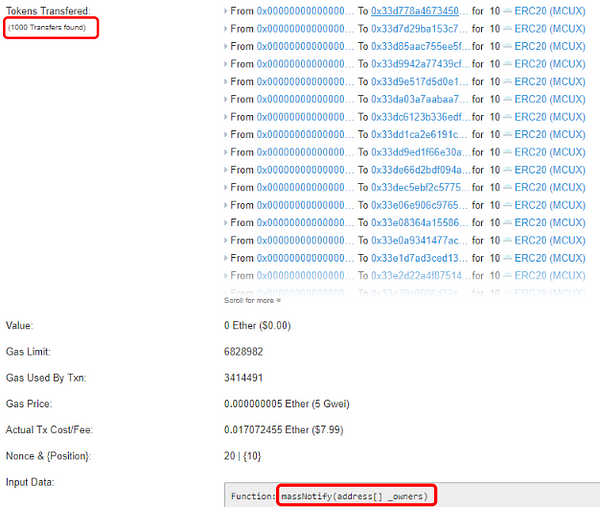
If you read the definition of the ERC20 standard you will find something well written and quite straight forward. But you will most likely also overlook one small detail that can make the world of difference in analyzing some contracts. It is in the relationship between the transfer() and transferFrom() methods and the Transfer() event. Take a look at this transaction for example.
Tools like Etherscan consider that there were 1000 tokens transferred by this message call. But upon closer inspection the method is called “MassNotify”. It doesn’t sound like a transfer to me. So what happened there? Why does it seem that 1000 tokens were issued when it is not the case?
The answer lies in this little detail that is easily overlooked: Transfer() must be triggered by token transfers, but it could be triggered for other reasons too! The wording of the standard is the following:
MUST trigger when tokens are transferred, including zero value transfers.
In the contract above what is called “virtual tokens” are issued at will and accounts are “notified” about it using the Transfer() event. That means that they are entered in a list of accounts that may transfer up to 10 tokens, provided it does not make the general supply reach the fixed limit. But until they do so, nothing in the contract ensures that they do have a token to spend. Such virtual tokens could be generated ad infinitum and completely throw off analyses of ERC20 tokens. The issue here in the etherscan analysis is that they used the Transfer() event log to get the information, which at the present state of the standard is not reliable.
You could suggest that we only count transfer() and transferFrom() message calls, but that would be a mistake again. Indeed nothing in the ERC20 standard currently suggests that these methods can only be called externally, by a message call. One could be called internally, inside another method. For example one could have an ERC20 contract with a shuffleAccounts(n)method, making n random calls to transferFrom(). That would appear in the Transfer() logs but not be seen by the method described above.
I suggest that any analysis of ERC20 token activity be preceded by a review of the contract’s code generating a list of method calls to be cross referenced with. As for virtual tokens, there is no way to know the individual state of accounts before they make their first use of their virtual tokens. I propose that in this case, counts should be capped by the total supply.
Source: https://medium.com/@LeData/analysing-erc20-activity-accurately-b8181c40b06b

Donnerstag, 6. Dezember 2018

Havven is transforming into Synthetix!

We are less than a week away from the launch of our synthetic asset platform that will support five fiat assets, eventually expanding to potentially hundreds.

This decision represents a refinement of the project’s purpose and was reached after extensive consultation with key members of our community.

With the upcoming launch of Synths — or what we previously called ‘multicurrency nomins’ — in the next few weeks, the Synthetix brand more accurately reflects what we see as the primary function of our system: enabling the creation of on-chain synthetic assets. This includes stablecoins pegged to the price of fiat currencies, as well as dollars pegged to the price of metals and indices.

Synths are backed by cryptoassets, meaning the collateral is resistant to censorship and seizure.

Here are the new names for the various aspects of our system:

Havven payment network → Synthetix Network
HAV (havven token) → SNX (Synthetix Network Token)
nomins → Synths
nUSD, nEUR, etc. → sUSD, sEUR, etc.
Why change from Havven?
Throughout the year, our team has been looking for an opportunity to improve upon Havven. We’ve been interested in finding a suite of brand elements with more cohesion, in which the relationships between each different part of the system was more intuitive. Our dual-token stability solution solves a critical issue in the ecosystem, and thus newcomers to our project will benefit from the various links between its elements being as clear as possible. This will be even more crucial when we are live on multiple blockchains, including EOSIO.

Why choose Synthetix?
While Havven was previously enabling the creation of a single stablecoin, nUSD, the new ‘multicurrency’ release provides so much more than just a stablecoin. Our collateral token, SNX, can now back a wide variety of synthetic assets, including dollars pegged to the price of fiat currencies, precious metals, indices, and even other cryptocurrencies. ‘Synthetix’ clearly and memorably expresses the function of the system in a way that ‘Havven’ did and could not.

What happens now?
We have already begun the process of reaching out to the most popular platforms, websites, and interfaces in the ecosystem, including CoinMarketCap, exchanges, and wallets, to inform them of the changes. We have asked them to switch over to Synthetix names and icons on Monday December 3, at 10:00am (UTC). Please give us up to 7 days for these changes to be implemented. If they are not yet carried out by then, please get in touch with us via email or Discord so we can reach out again to those platforms. There are no contract address changes, so nothing should occur to your tokens except for a name change.

source: https://blog.havven.io/havven-is-transforming-into-synthetix-2fdf727b8892

Samstag, 1. Dezember 2018

Nace la primera asociación de blockchain en México

La Asociación Blockchain México, la primera institución de esta tecnología en el país, estará conformada por Bitso, Volabit, BIVA, GBM, Lvna Capital, ConsenSys y Exponent Capital.


“Esta tecnología tiene el objetivo de crear procedimientos más transparentes, seguros y eficientes”, afirmó Felipe Vallejo, presidente provisional de la Asociación Blockhain México.
Esta unión de organizaciones quiere educar a los ciudadanos en el uso de esta tecnología cuyas aplicaciones potenciales aún se desconocen.
Los integrantes también quieren asegurarse de que, antes de que se vuelva una herramienta masiva, se fijen unos estándares para un uso seguro y de calidad. Esto, con la intención de evitar malas prácticas a través del blockchain, como lavado de dinero.
“Las aplicaciones actuales del blockchain van desde la disminución de los costos de envío de remesas y pagos internacionales, hasta la democratización del sistema financiero”, explicaba el fundador de Exponent Capital, Mouses Cassab.
Inspiración y crecimiento
La Asociación Blockchain México se inspira en asociaciones que ya existen en otros países. Por ejemplo, el Congressional Blockchain Caucus, en Estados Unidos; el Cripto Valley, en Suiza, y e-Estonia.
Aunque la Asociación nace con siete integrantes, está abierta a cualquier entidad y organización que se quiera sumar. Esto es porque la tecnología blockchain se puede aplicar en todas las industrias.
“Tenemos ganas de generar un espacio de discusión y política publica. Queremos que todos puedan exponer sus ideas”, dijo la directora de BIVA, María Ariza.
 ¿Qué es el blockchain?
La tecnología blockchain funciona como un documento de Google o Google Doc.
Se trata de una cadena de información en la que todos los integrantes tienen acceso a los datos que se registran en el documento en la nube.
Esto permite que nadie quede ajeno de cualquier cambio que se produce en el proceso o acto registrado. Es más, no se puede introducir ningún cambio en los datos sin la autorización de todos los miembros de la cadena.
Un ejemplo sería el proceso de producción de zapatos. Con el blockchain, los compradores podrían ver todo el historial del proceso de producción de unas botas y comprobar que están hechas de piel sintética.
¿Qué se gana con esto? Confianza sin necesidad de que la intervención de un tercero, una agencia de control de calidad de productos, por ejemplo.
Esto es un cambio de lógica, porque hasta el momento, cuanto más cerradas eran las entidades, un banco, por ejemplo, más seguras eran.

En blockchain, la seguridad la garantiza la apertura de los datos a los ciudadanos.

Source: https://www.forbes.com.mx/nace-la-primera-asociacion-de-blockchain-en-mexico/
Visitors:

luvne.com resepkuekeringku.com desainrumahnya.com yayasanbabysitterku.com